
English · Coming soon
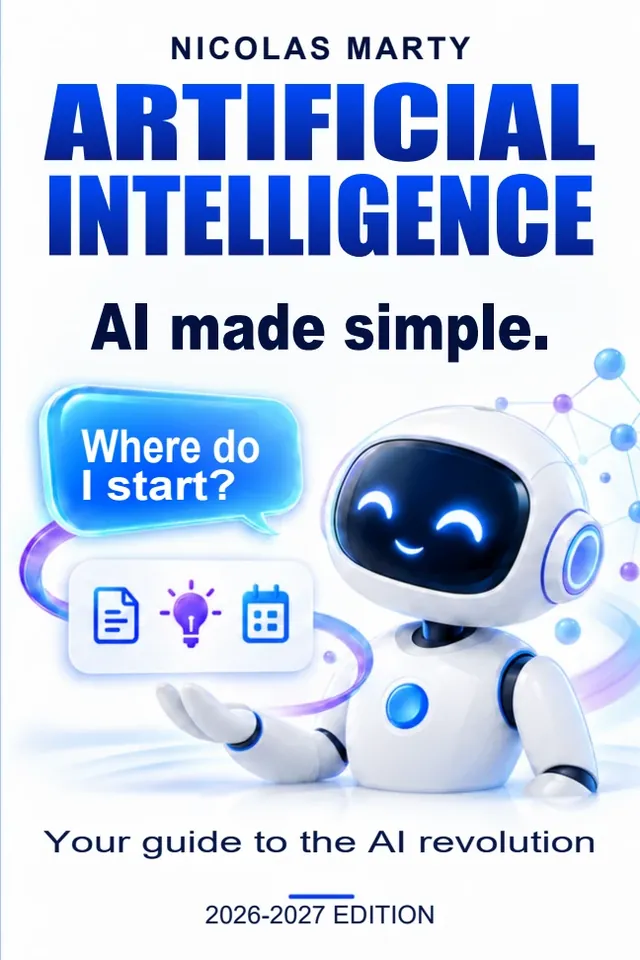
Artificial Intelligence
AI made simple.
You have a task in mind, a blank prompt in front of you and no idea what to type. This illustrated guide starts there, with a small request you can actually try.
Nicolas Marty
Try one small request
Choose a short email you want to rewrite or a topic you want explained. Give the assistant a reader, a purpose and a limit. Read its answer aloud. The parts you would change are often the most useful starting point for your second request.
Follow an idea through seven projects
The guide moves from first experiments to practical projects and an introduction to agents. You can return to the same prompt as you read, compare two answers and decide which details deserve a separate check.
Explore the illustrated presentation

Understand AI. Take your first steps.
An assistant can produce convincing writing without giving a correct answer. Everyday situations introduce what a model is, how it learns and what happens when we use it. Explanations, diagrams and a glossary introduce the vocabulary as it becomes useful. You do not need an IT background or advanced mathematics to begin.

Clearer requests, closer checking
Define an objective, provide relevant context and ask for a useful format. Learn how to write clear prompts, improve an answer through dialogue, compare it with sources and identify what still needs checking.

Seven projects to put ideas into practice
Turn a document into a discovery resource, prepare a brochure, organise sources or build a checkable spreadsheet. The projects then move towards a small application, a bounded agent task and an ongoing routine.

A gradual introduction to agents
Explore what changes when an assistant uses tools and works through several steps. The guide addresses memory, sources and task boundaries, helping you define the expected outcome and retain control over its validation.
An AI book for beginners and curious readers.
Follow the chapters in sequence or return to a particular question: understanding an error, framing a request, preparing sources or defining a task. Examples, explanatory diagrams and a glossary support the reading. The second part explores agents in greater depth, building on the foundations without expecting you to master everything at the start.